Skip to content
No results
  • Contents
    • Docker
    • Kubernetes
    • Network Automation
    • Cloud Platforms
      • OCI
        • IAM
        • OCI Networking
      • Professional Cloud Architect
      • Cloud Network Engineer
      • Google Cloud Network Engineer Practice Tests
      • OCI for GCP Architects
    • GIT & Version Control
    • Terraform Articles
      • Terraform-AWS-Labs
      • Terraform-GCP-Labs
      • Terraform Practice Lab
      • terraform-practice-tests
    • Multicast
    • ACI
  • About Me
ethernetdude
  • OCI, IAM

Article 02 – OCI Identity Domains: Architecture, Types, and Directory Management
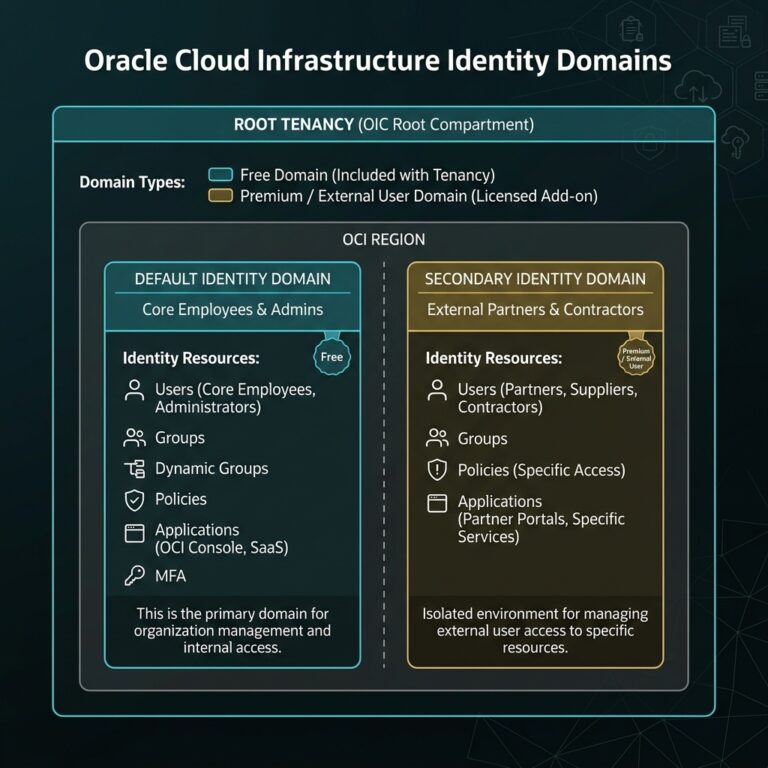
1. Introduction to OCI Identity Domains In Oracle Cloud Infrastructure (OCI), human user accounts, administrative credentials, security groups, and single sign-on (SSO) configurations are governed by Identity Domains. An Identity Domain is a container for managing users, groups, authentication policies,…
  • OCI, IAM

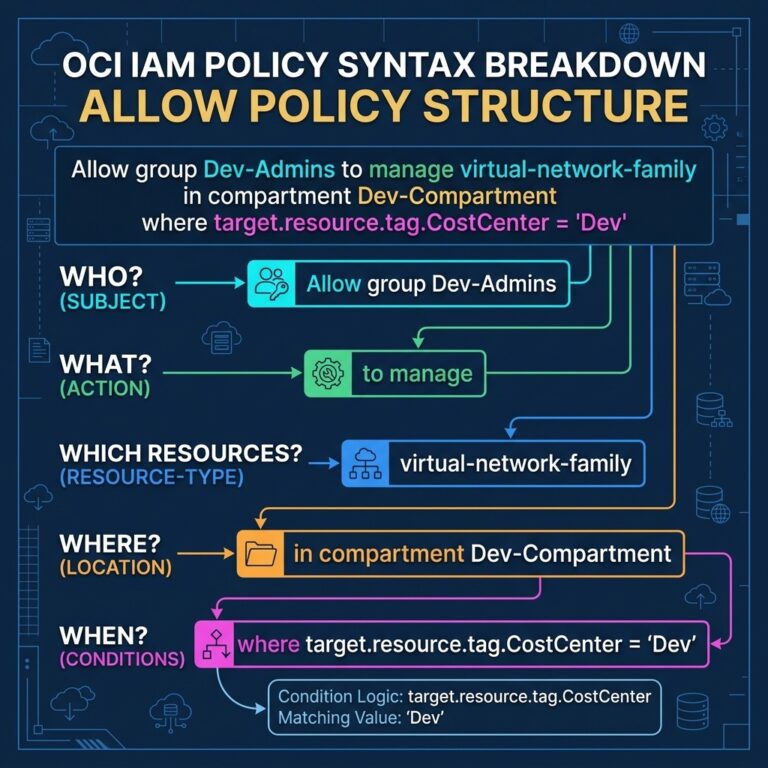
Article 03 – OCI Policy Language Fundamentals: Syntax, Verbs, and Scope

1. Introduction to the OCI Policy Engine In Oracle Cloud Infrastructure (OCI), authorization is controlled by a plain-text, SQL-like declarative policy language. Unlike platforms that rely on complex JSON permission documents or predefined role assignments, OCI policies use human-readable statements…

  • OCI, IAM

Article 04 – Resource Types and Resource Families: Precision Access Control

1. Introduction to OCI Resource Target Scoping In Oracle Cloud Infrastructure (OCI) policy statements, the target of an action is defined by a Resource Type or a Resource Family. Rather than requiring administrators to reference individual API permission strings for…

  • OCI, IAM

Article 05 – Advanced Policy Conditions and Clause Tuning: Fine-Grained Governance

1. Introduction to Policy Conditions In Oracle Cloud Infrastructure (OCI), basic policy statements evaluate access based on Subject, Verb, Resource, and Location. However, enterprise security standards frequently require fine-grained access constraints—such as allowing operations only during business hours, restricting administrative…

  • OCI, IAM

Article 06 – Identity Groups and Access Control Management: User Provisioning & Group Architectures

1. Introduction to OCI Group-Based Governance In Oracle Cloud Infrastructure (OCI), administrative permissions are granted strictly to Groups, never directly to individual human user accounts. This group-based governance model enforces the principle of Least Privilege and simplifies security auditing. When…

  • OCI, IAM

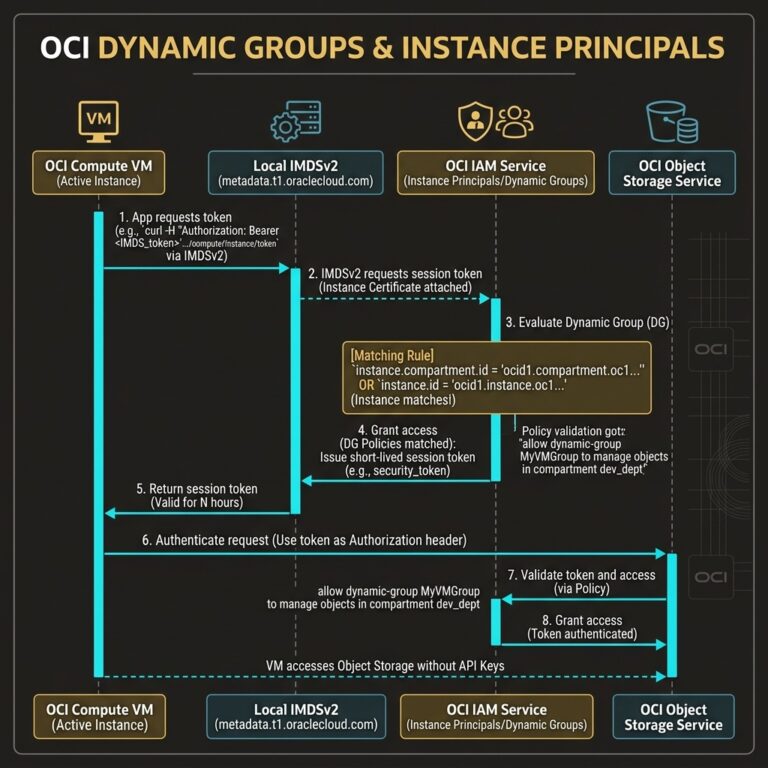
Article 07 – Dynamic Groups and Instance Principals: Credential-Less Service-to-Service Security

1. Introduction to Credential-Less Authentication When applications running on compute instances interact with cloud services—such as uploading files to Object Storage or querying Autonomous Databases—storing hardcoded API signing keys, passwords, or credentials on the server disk introduces severe security risks.…

  • OCI, IAM

Article 08 – Resource Principals & Workload Identity: Authorization for OKE, Functions, and Automation

1. Introduction to Resource-Level Authentication While Instance Principals authorize compute virtual machines, modern cloud architectures rely heavily on serverless workloads (OCI Functions), cloud automation (Cloud Shell), and containerized microservices operating inside Container Engine for Kubernetes (OKE). For these non-VM workloads,…

  • OCI, IAM

Article 09 – Network Sources: Restricting Access by IP and Subnet Boundaries

1. Introduction to Network Sources In enterprise cloud security, user credentials alone are often insufficient to grant high-privilege access. Organizations must enforce location-aware access control, ensuring that administrative actions can only be performed when requests originate from authorized network locations.…

  • OCI, IAM

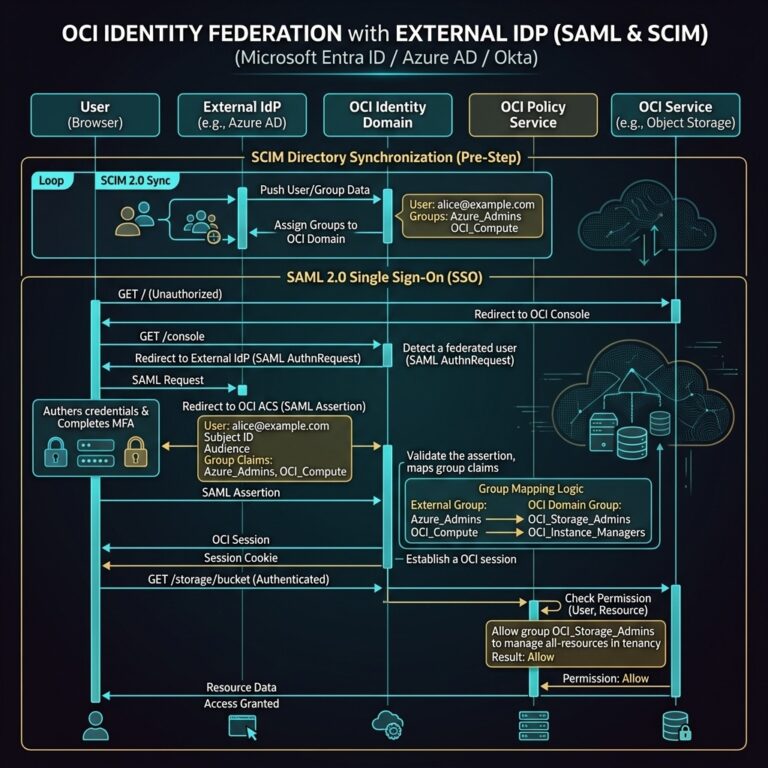
Article 10 – Identity Federation & Single Sign-On (SSO): Integrating Entra ID, Okta, and SAML 2.0

1. Introduction to Enterprise Identity Federation In modern enterprise architectures, organizations maintain a centralized identity directory—such as Microsoft Entra ID (formerly Azure AD), Okta, or Ping Identity. Requiring employees to manage separate login credentials for Oracle Cloud Infrastructure introduces credential…

  • OCI, IAM

Article 11 – Multifactor Authentication (MFA), Password Policies, and Risk-Based Sign-On Rules

1. Introduction to Authentication Hardening Securing administrative access to Oracle Cloud Infrastructure (OCI) requires robust authentication controls. Credential compromise remains a primary attack vector targeting enterprise cloud environments. OCI Identity Domains provide native Multifactor Authentication (MFA), customizable Password Policies, and…

Prev
1 2 3 4 5 6 … 34
Next

[email protected]

Establish a Persistent Connection

Like the content ? Get notified when I post something new. I promise not to spam your Email.

Name
Enter your email address