Article 18 – Networking Troubleshooting & Diagnostic Mechanics: Break-Fix Lab
1. Introduction to Network Diagnostic Engineering Even meticulously designed Oracle Cloud Infrastructure (OCI) network architectures encounter operational failures due to routing misconfigurations, missing Security List rules, stateless firewall return-path drops, asymmetric firewall routes, or BGP tunnel flaps. When an application…
Article 17 – OCI Network Observability: VCN Flow Logs, Network Visualizer, and Route Analyzer
1. Introduction to OCI Network Observability Operating enterprise cloud infrastructure requires continuous visibility into network traffic patterns, performance bottlenecks, security policy evaluation, and routing topologies. Without robust observability tools, diagnosing dropped packets, investigating security breaches, or auditing compliance boundaries becomes…
Article 16 – Web Application Firewall (WAF) & Edge Network Security
1. Introduction to Layer 7 Perimeter Protection Public-facing web applications and APIs are continuously targeted by sophisticated application-layer cyber threats—including SQL Injection (SQLi), Cross-Site Scripting (XSS), Remote Code Execution (RCE), Credential Stuffing, and Automated Bot Scrapers. Standard Layer 3/4 firewalls…
Article 15 – OCI DNS Services, Private DNS, and Hybrid Name Resolution
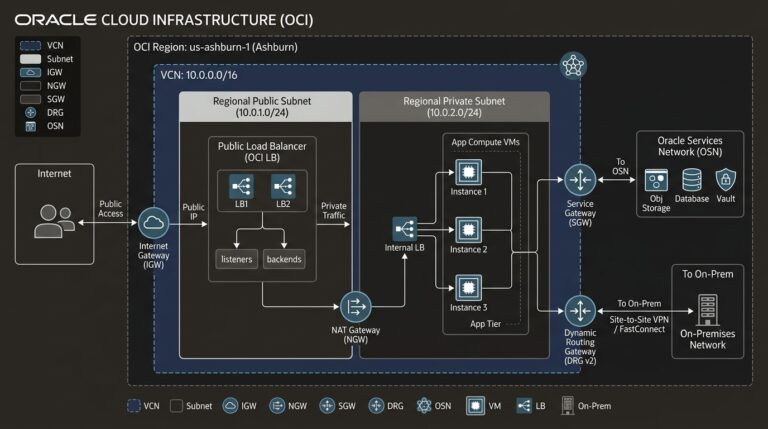
1. Introduction to Enterprise Cloud DNS Reliable Domain Name System (DNS) resolution is critical for enterprise cloud operations. Compute instances, microservices, databases, and hybrid on-premises applications rely on DNS to discover endpoints dynamically without hardcoding volatile IP addresses. Oracle Cloud…
Article 14 – Advanced Routing: Transit Hub VCNs and Next-Gen Firewall Insertion
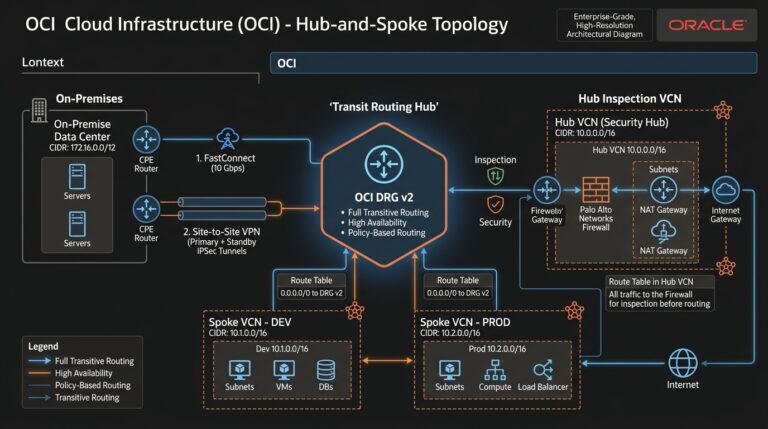
1. Introduction to Centralized Transit Security Architecture Enterprise security compliance often mandates that all network traffic—whether moving between internal cloud subnets (East-West traffic) or between cloud workloads and the internet/on-premises (North-South traffic)—must undergo deep packet inspection (DPI) through Third-Party Next-Generation…
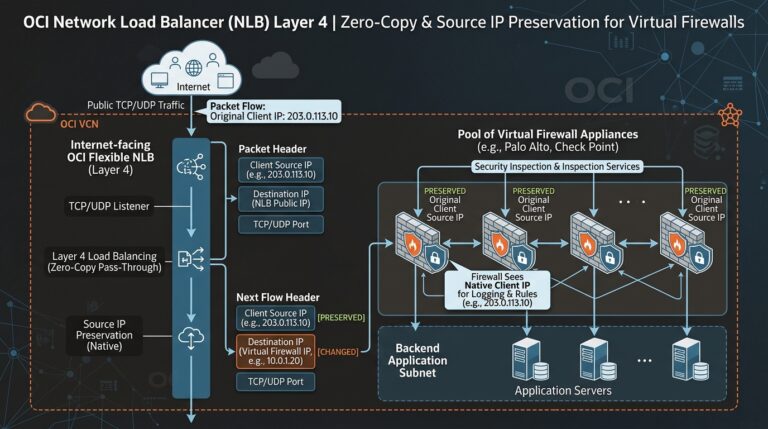
Article 13 – Network Load Balancer (Layer 4): Ultra-Low Latency & High-Throughput Distribution
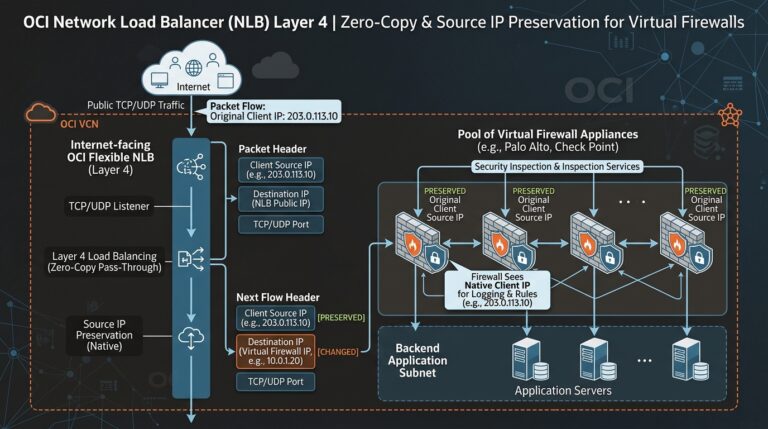
1. Introduction to Layer 4 Network Load Balancing While Layer 7 load balancers analyze HTTP/HTTPS application payloads, high-performance network architectures—such as financial trading systems, gaming servers, database clusters, VoIP media gateways, and virtual firewall inspection hubs—require maximum packet throughput and…
Article 01 – OCI Networking Architecture: VCNs, Subnets, Gateways, and VNICs
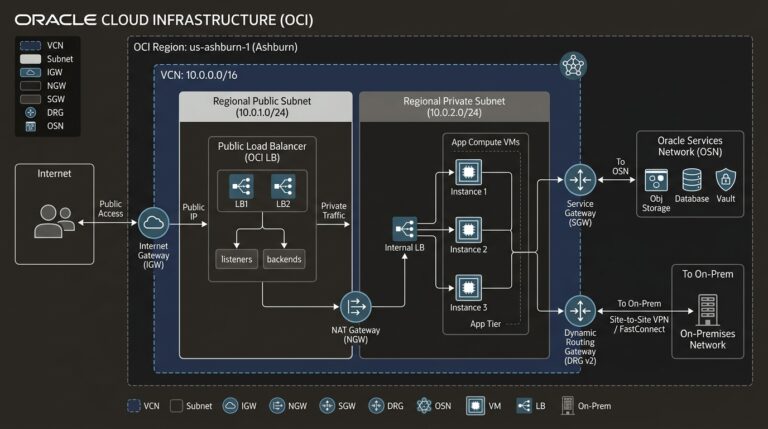
1. Introduction to OCI Network Virtualization Oracle Cloud Infrastructure (OCI) approaches network virtualization differently from first-generation public clouds. Rather than running network abstraction layers inside hypervisor software on host CPUs—which introduces latency jitter and noisy-neighbor contention—OCI decouples network virtualization entirely…
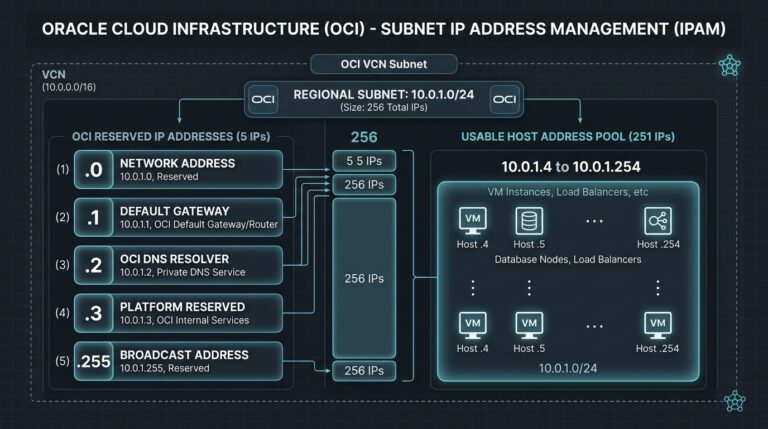
Article 02 – Subnets, CIDR Sizing, and IP Address Management (IPAM)
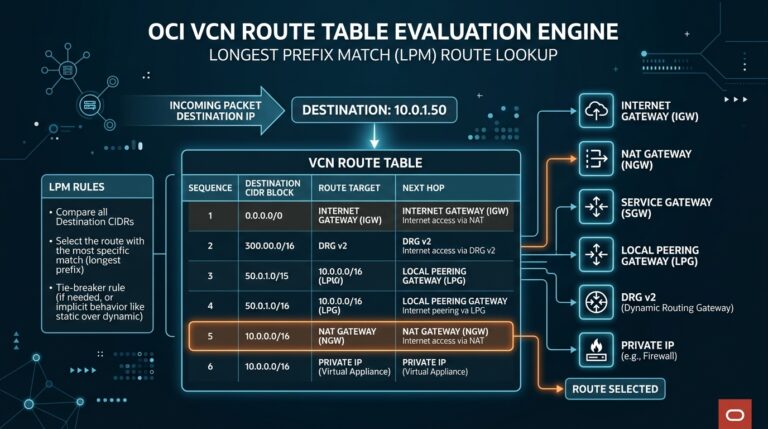
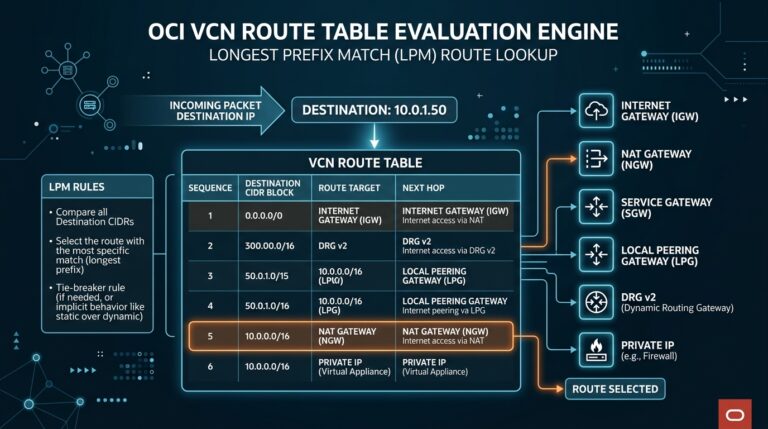
Article 03 – OCI Route Tables and Routing Mechanics