The Oracle Database Migration Challenge
In many cloud environments, running Oracle Database is an operational bottleneck. Because major hyperscalers do not have a native, first-party managed service for Oracle Database, architects are forced to deploy Oracle on standard compute VMs (running on self-managed hypervisors) or utilize co-located, non-integrated physical hardware (like Google Cloud’s Bare Metal Solution).
This self-managed approach places a heavy burden on database administrators (DBAs), who must manually configure backups, tune storage configurations, handle OS and DB patching, and orchestrate complex high-availability clusters using Oracle Grid Infrastructure.
Oracle Cloud Infrastructure (OCI) resolves these challenges. Since Oracle Database is native to Oracle hardware and software, OCI provides a tiered family of managed database services, ranging from entry-level Virtual Machines to fully automated, self-driving Autonomous Databases running on specialized Exadata systems.
OCI Database Architecture Portfolio
OCI categorizes its database offerings based on the level of control and performance you require:
1. Base Database Service (VM and BM)
The entry-level managed service, allowing you to run Oracle Database on standard VM or Bare Metal shapes.
* Managed Lifecycle: OCI handles automated backups, patching, and scaling via the console or CLI.
* Admin Access: Unlike standard managed databases, you retain full root access to the underlying OS and database host, allowing you to run custom scripts, configure third-party agents, and install legacy database plugins.
* This is equivalent to GCP’s Cloud SQL model, but with host-level access.
2. Exadata Database Service
For high-performance enterprise database workloads, OCI offers the Exadata Database Service.
* Runs on specialized Exadata hardware, which integrates high-performance compute nodes, smart storage servers, PCI NVMe flash storage, and an ultra-fast InfiniBand/RDMA network backbone.
* Designed to handle massive online transaction processing (OLTP) and complex data warehousing workloads simultaneously.
* GCP has no equivalent native service for Exadata.
3. Autonomous Database
The highest level of database automation. The Autonomous Database is a fully self-driving, self-securing, and self-repairing database running on Exadata infrastructure.
* No DBA Required: OCI automatically handles database provisioning, tuning, indexing, physical schema optimization, backups, security updates, and OS patching.
* Auto-Scaling: Automatically scales CPU and storage resources up to 3x on the fly based on real-time query load, with zero downtime.
* Workload Tiers:
* Autonomous Transaction Processing (ATP): Optimized for OLTP workloads (high-concurrency, short transactions).
* Autonomous Data Warehouse (ADW): Optimized for analytical workloads (complex, long-running queries).
* Deployment Options:
* Serverless (Shared): Multiple customer databases share a pool of Exadata infrastructure. (Lowest cost, zero management).
* Dedicated: You lease a dedicated Exadata rack in OCI, giving you complete isolation and control over patch schedules.
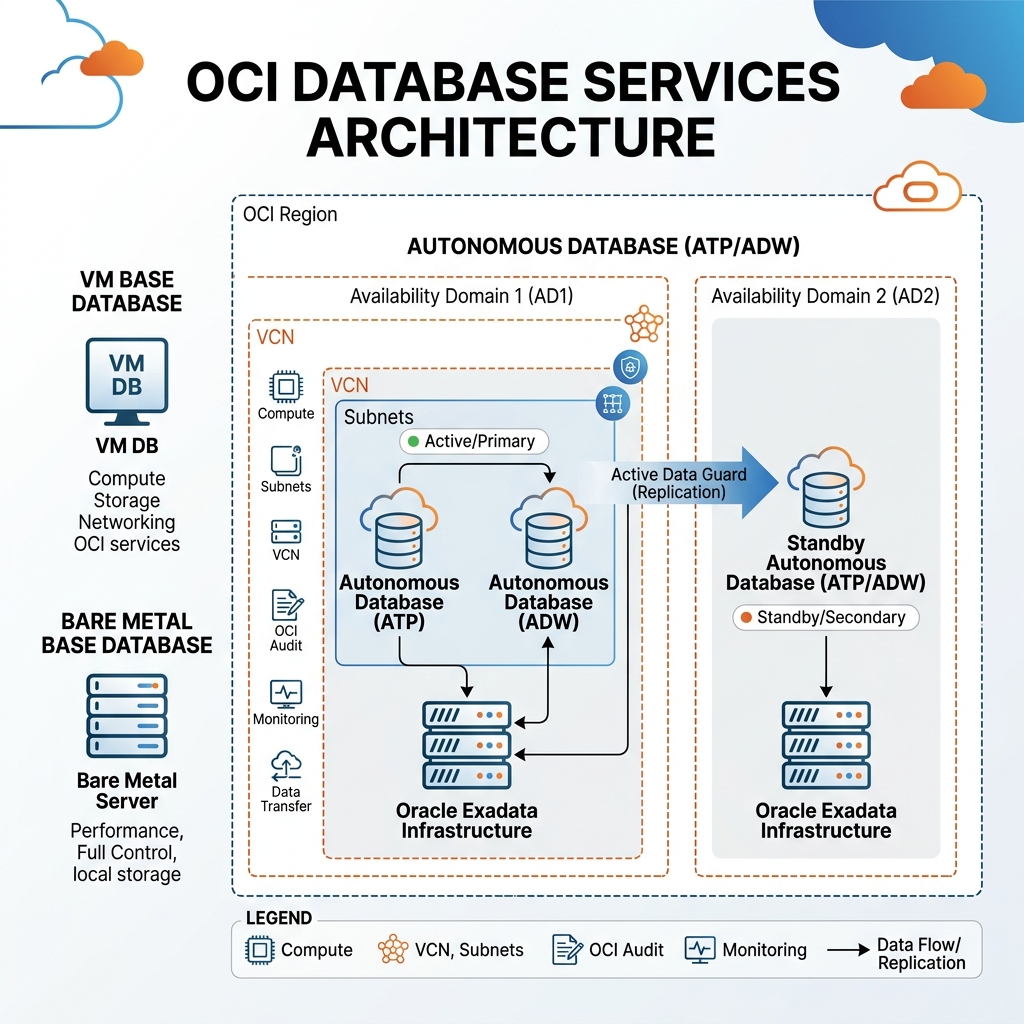
Here is the architectural layout of OCI Database options, including Autonomous Database deployments and replication via Active Data Guard:
High Availability: Data Guard vs. Active Data Guard
To ensure business continuity, OCI includes native database replication through Data Guard and Active Data Guard. (Equivalent to cross-region read replicas in GCP Cloud SQL).
- Data Guard: Replicates data from a primary database to a standby database (in a different AD or region). The standby database is in a mounted state and cannot accept queries. If the primary fails, you can trigger a failover to promote the standby.
- Active Data Guard: The standby database remains open in read-only mode while replication is active. You can offload heavy reporting queries and read-only API traffic to the standby database, freeing up resource capacity on the primary.
Declarative Provisioning via Terraform
Instead of scripting manual CLI commands, you configure OCI Database systems using Terraform. The following configuration defines a serverless Autonomous Transaction Processing (ATP) database running on shared Exadata infrastructure, configured with CPU auto-scaling:
# Create a serverless Autonomous Transaction Processing (ATP) Database
resource "oci_database_autonomous_database" "prod_atp" {
  compartment_id           = "ocid1.compartment.oc1..aaaaaaaadevvv..."
  db_name                  = "ProdATP"
  cpu_core_count           = 1
  data_storage_size_in_tbs = 1
  db_workload              = "OLTP"
  admin_password           = "Strong_Password_123#"
  display_name             = "Production-ATP"

  # Deploy on shared infrastructure (Serverless)
  is_dedicated             = false

  # Enable automatic scaling for CPU and storage
  is_auto_scaling_enabled  = true

  # Optional: Configure licensing model (BYOL or License Included)
  license_model            = "LICENSE_INCLUDED"
}
By leveraging OCI’s database portfolio—from entry-level Base databases to self-tuning Autonomous Databases—and declaring these configurations using Terraform, you can build data platforms that scale to support extreme workloads while offloading routine DBA operations to Oracle’s automated control plane.